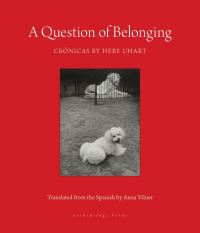
A Question of Belonging

£19.99

Uhart reinvigorates our desire to connect with other people, to love the world, to laugh in the face of bad intentions, and to look again, more closely: from lapwings, road-side pedicures, and the overheard conversations of nurses and their patients, to Goethe and the work of the Bolivian director Jorge Sanjines. ‘It was a year of great discovery for me, learning about these people and their homes,’ Hebe Uhart writes in the opening story of A Question of Belonging, a collection of texts that traverse Argentina, Paraguay, Brazil, Spain, and beyond. Discoveries sprout and flower throughout Uhart’s oeuvre, but nowhere more so than in her cronicas, Uhart’s preferred method of storytelling by the end of her life. For Uhart, the cronica meant going outside, meeting others. It also allowed the mingling of precise, factual reportage and the slanted, symbolic narrative power of literature. Here, Uhart opens the door on all kinds of people.

In stock

One copy is currently available in store.
This title can be ordered for collection in store or for home delivery.
If you require more copies than we have available in the shop we can order these for you – this usually just takes a day or two, but we will confirm the expected timeframe when an order is placed.

SKU: 9781953861801 Category: Tag: Publisher/imprint : Archipelago Books
Page count : 241
Published on 28th May, 2024

Description

Uhart reinvigorates our desire to connect with other people, to love the world, to laugh in the face of bad intentions, and to look again, more closely: from lapwings, road-side pedicures, and the overheard conversations of nurses and their patients, to Goethe and the work of the Bolivian director Jorge Sanjines. ‘It was a year of great discovery for me, learning about these people and their homes,’ Hebe Uhart writes in the opening story of A Question of Belonging, a collection of texts that traverse Argentina, Paraguay, Brazil, Spain, and beyond. Discoveries sprout and flower throughout Uhart’s oeuvre, but nowhere more so than in her cronicas, Uhart’s preferred method of storytelling by the end of her life. For Uhart, the cronica meant going outside, meeting others. It also allowed the mingling of precise, factual reportage and the slanted, symbolic narrative power of literature. Here, Uhart opens the door on all kinds of people. We meet an eccentric priest who conducts experiments down by the riverside hoping to land on a cure for cancer; a queenly (read: beautiful and relentlessly indolent) teenage girl; a cacique of the Pueblo Nacion Charrua clan, who tells her of indigenous customs and histories. She writes with characteristic slyness. In the last lines of the title story, Uhart writes, ‘And I left, whistling softly.’ Wherever she may have gone, we are left with the wish we could follow alongside.

Additional information

Weight 0.248 kg
Dimensions 16.5 × 13.9 × 1.8 cm
Author

Publisher

Imprint

Cover

Pages

Language

Edition
Dewey
Readership